


For decades, B2B marketing has been steered to play it safe, building campaigns around logic – specifications, data sheets, ROI calculations – all while assuming that B2B marketing doesn’t require emotions like B2C does, and that cold, hard facts and figures will seal the deal.
But here, at S2F, we want to share a real and uncomfortable truth with you: they won’t.
90% of the buying decisions are made subconsciously. They are emotional first – and only justified with logic later. So, if your marketing speaks to the rational mind alone… who are you really marketing for?
As a B2B marketing agency, we know that marketing is about driving conversions and increasing your ROI – but we also know that it needs to be much more; it needs to be about creating connection. After many, many years of allowing rational logic to dominate marketing strategies, we are being inundated with research from VML, LinkedIn, Kantar, and BrandFinance that proves what great brands have always known: Emotion wins. Always.
Studies have reached a consistent average showing that between 65% to 70% of B2B buying decisions are emotionally driven. Even in the boardroom, the stakeholders are human first, leaders of the decision-making process later. Earlier, we said that 90% of the decisions are made subconsciously – this is not a figure taken out of thin air; it is the result of scientists studying the brain for over five decades. This is the reason why emotion-led campaigns consistently outperform logic-first strategies.
The ROI in emotion is undeniable. Brands that lean into emotional marketing in B2B and form connections see higher engagement, stronger loyalty, and a greater pipeline value.
Rational messaging might make sense – but emotion makes the sale.
As a copywriter, I believe that words deliver the most important message. A visual narrative that sparks excitement and/or builds reassurance will only strengthen your message and keep your audience leaning in. However, I am not oblivious to the fact that the design of a campaign is the first thing people see. They are attention grabbers; they need to be impactful, look good, and most importantly, they need to make people feel something. From colour psychology to typography and imagery, every creative decision has the power to spark trust, excitement, and/or curiosity.
At S2F, our creative process always starts with the same question: what do we want our clients’ audience to feel? It’s not an easy process, though.
We are met with resistance by more traditional and rational minds still believing that a campaign entirely focused on the benefits and specifications will be the campaign that makes them shine – but we keep fighting for the right approach, we keep asking the right questions, and we keep putting our best foot forward for better, more emotive campaigns. When you write and design with intention, every detail of your strategy becomes purposeful.
But you shouldn’t really switch and change the way a brand looks with every campaign you work on. Consistency is where emotion becomes equity. Every touchpoint – your logo, your fonts, your social tiles – reinforces the emotional state your audience associates with your brand. Over time, familiarity will build trust. And those first impactful impressions will turn into lasting connections, and the brand becomes one they will remember.
Once you have an audience that remembers you, there is one truth that holds up regardless of industry: your audience – likely buyers – are human first, buyers second. It doesn’t matter if they are buying car cleaning products, soliciting consultancy services, or manufacturing components that are part of the global supply chain; emotion drives trust and, ultimately, action.
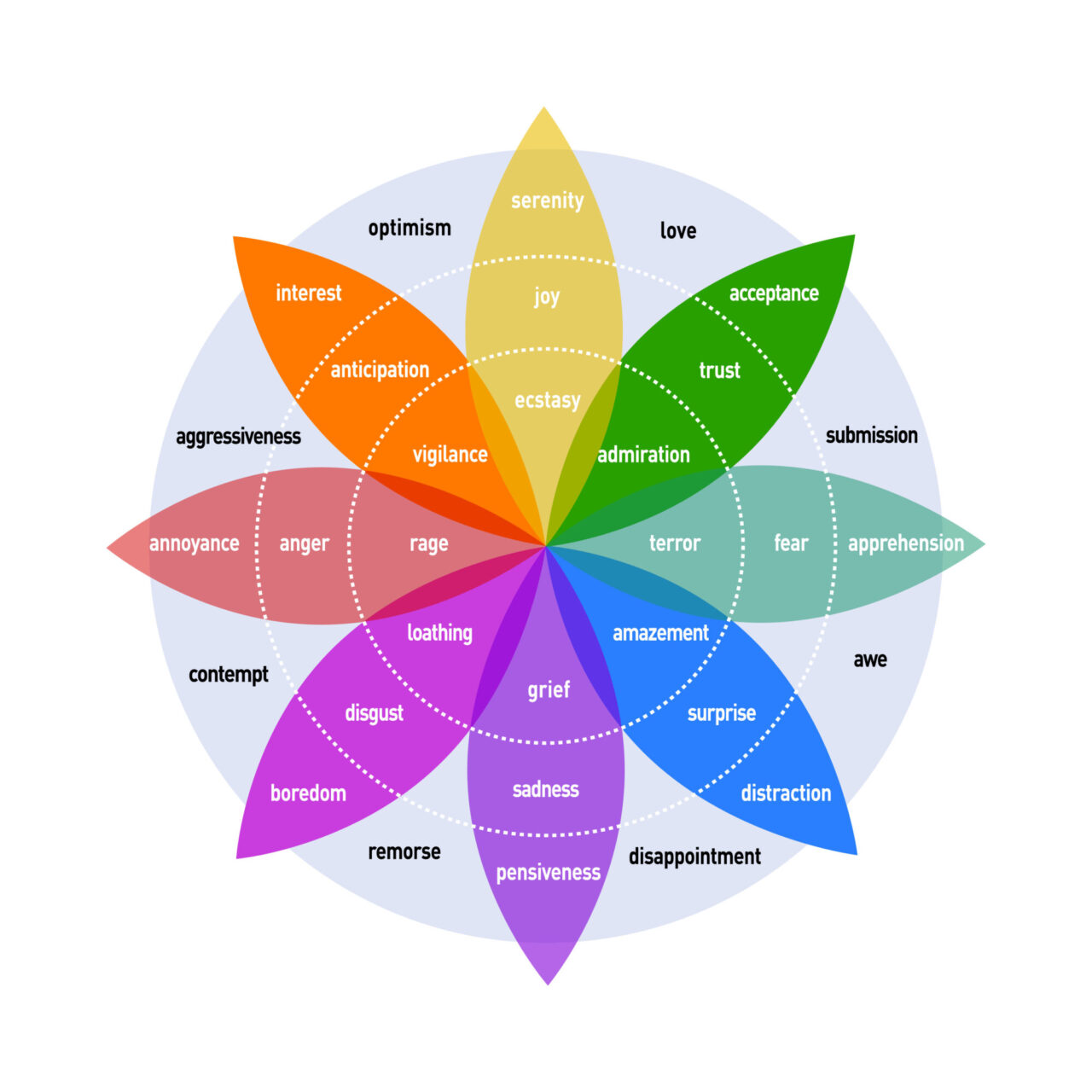
Plutchik’s Wheel of Emotion, simplified for emotional marketing, reminds us that certain emotional triggers – like trust, excitement, or reassurance – spark connection, while others, like confusion or fear, erode it. The key is understanding which emotional drivers matter most to your audience.
The most successful campaigns should use three to four different techniques simultaneously while maintaining brand consistency. The growing use of technology and AI means we are constantly searching for new ways to create emotional connections whilst still relying on the fundamental human psychological triggers.
Collateral selection comparison across emotions:

But nothing is ever black and white, and emotional marketing has a significant nuance: emotions aren’t universal; they are contextual. What excites a Gen Z buyer might feel risky or frivolous to a Gen X procurement lead. That is why you should not segment by job title or industry; you should map emotional triggers unique to your audience and build messages that speak to those needs.
Most social media platforms will give you a demographic breakdown that allows you to establish the most popular age range for your content. Then your campaigns can start taking shape. If your audience is Gen Z buyers, you might benefit from a strategy that is bold and elicits curiosity. If you are catering to an older generation, you may prefer simplistic and clear content that inspires confidence.
But we get it – once you have all the information… How do you translate it into campaigns that work? Well, by making emotion the starting point, obviously!
The best emotional campaigns balance feeling with fact. Storytelling becomes the bridge between emotional resonance and rational proof. A case study shouldn’t just be a KPI dump; it should be a story about a real human, in a real world, solving a real problem with your very real help. And in the middle of that story is where trust is built and decisions are made.

And it’s precisely those decisions that should be at the centre of our target. B2B decisions are not day-to-day decisions about whether or not to colour-match your socks; they carry high stakes and personal risk.
“The fact is that a B2B purchasing decision is a massively emotional one.The stakes are high and so are the investments; the buyer’s reputation, trustworthiness, and potentially future success are all on the line.”
HubSpot’s Amy Marino on the LinkedIn Collective
That is why a successful B2B brand will not just sell the features or price; they’ll sell confidence, trust, and clarity.
On the other hand, you can also focus on the “wrong” emotions if there are “wrong” emotions at all. Because an easy emotion to tackle would be fear: fear of not getting promoted, of making a bad decision, of criticism, of the unknown, of feeling like an impostor, etc. Even at the project level, there is often a thought at the back of every creative’s mind on whether they are using unconventional messaging, or “too-bold” visuals; most times backing down before deciding purely because of fear of negative feedback. And what do we need when we are scared? Reassuring words.
But how do you tackle these deeply personal and complex emotions when there are multiple decision makers in the process? We can tell you that buying is an intricate and challenging process. Research from Gartner says that “The typical buying group for a complex B2B solution involves six to 10 decision-makers, each armed with four or five pieces of information they have gathered independently and must de-conflict with the group… These dynamics make it increasingly difficult for customers to make purchases. More than three-quarters of the customers Gartner surveyed described their purchase as very complex or difficult.”
“Today’s business buyers do not contact suppliers directly until 57 per cent of the purchase process is complete… That means for nearly two-thirds of the buying process, your customers are out in the ether: Forming opinions, learning technical specifications, building requirements lists, and narrowing down their options, all on their own, with minimal influence from you. It’s marketing’s job to influence the 57 per cent of the sale that occurs mostly on the web, before sales contact…”
Think with Google)
But let’s be honest: regardless of industry, whatever you can offer, there are a dozen more just around the corner, where products/services, prices, and features are nearly identical. Therefore, what sets you apart is how you make your buyers feel. Emotional clarity makes complex decisions simpler. If you are buyers feel confident, reassured, and excited about your brand, they are far more likely to choose you.
You can do so by utilising messaging that reassures buyers and reduces perceived risk, content that positions you as a trusted authority, and create campaigns that cut through the more rational, “safe” landscapes straight through to make authentic, human connections.
So yes, a content strategy needs more than cold, hard facts; however, turning emotional insight into action doesn’t have to be overwhelming. You can start here, with us, with S2F.
We can check your current content for emotional resonance, identify the main core emotional drivers of your brand, build consistency across your touchpoints and channels, measure what truly matters (not just clicks and conversations, but engagement depth, brand recall, and trust metrics), and test and iterate strategies to find what works best for you long term.
You can start small, but it is important to start now. Because in B2B marketing – just as in life – people don’t remember what you said; they remember how you made them feel.
Feeling drives action. Always.
For further information on how S2F can help you incorporate emotions in B2B Marketing, call 0121 607 1908.
You can also follow us on LinkedIn for more insightful pieces like this one.
Not exclusively. Research from LinkedIn, Kantar, and BrandFinance shows that 65–70% of B2B buying decisions are emotionally driven, even when the justification is rationalised later with ROI or specs. Decision-makers are human first, and emotions like trust and confidence play a bigger role than data alone. Emotional marketing goes hand-in-hand with traditional marketing.
The most effective campaigns tap into emotions like trust, optimism, anticipation, admiration, and reassurance. These feelings inspire confidence and connection, while negative emotions such as confusion or fear can derail the buying process. Emotions in marketing are very powerful, but they have to be used right!
Beyond clicks and conversions, marketers can measure the emotional resonance from emotional marketing through brand recall, trust metrics, engagement depth, and loyalty indicators. Studies show that emotion-led brands see higher engagement rates (+60% on joy-focused campaigns) and stronger lead conversion rates (+45% on trust-driven campaigns).
It’s about balance. Emotional storytelling draws people in, while rational proof (case studies, certifications, performance data) reassures them. The strongest B2B marketing campaigns use both, starting with emotions and backing it up with logic.
Because buyers are already 57% of the way through their purchasing process before speaking to a supplier (Think with Google). By the time they reach you, opinions are formed. The brands that win are the ones that connected with buyers emotionally during that silent 57%.
To request our services, you can email us at info@s2fmarketing.co.uk or call us on 0121 607 1908. And to keep up with the latest news and events from S2F and the team, you can follow us on Instagram, Facebook, and LinkedIn!

Andrea Gardia
Content Creator
Other articles:
Bridge the gap and build your network with S2F Connect
20 years of S2F: garage doors to glass doors
Top 10 website trends for businesses in 2025